Grouted connections — fatigue methodology endorsed by Inge Lotsberg (DNV); conical and shear-key variants; 3D non-linear FE.
Pile-driving impact — transient dynamic LS-DYNA simulations for ring-stiffener and flange details.
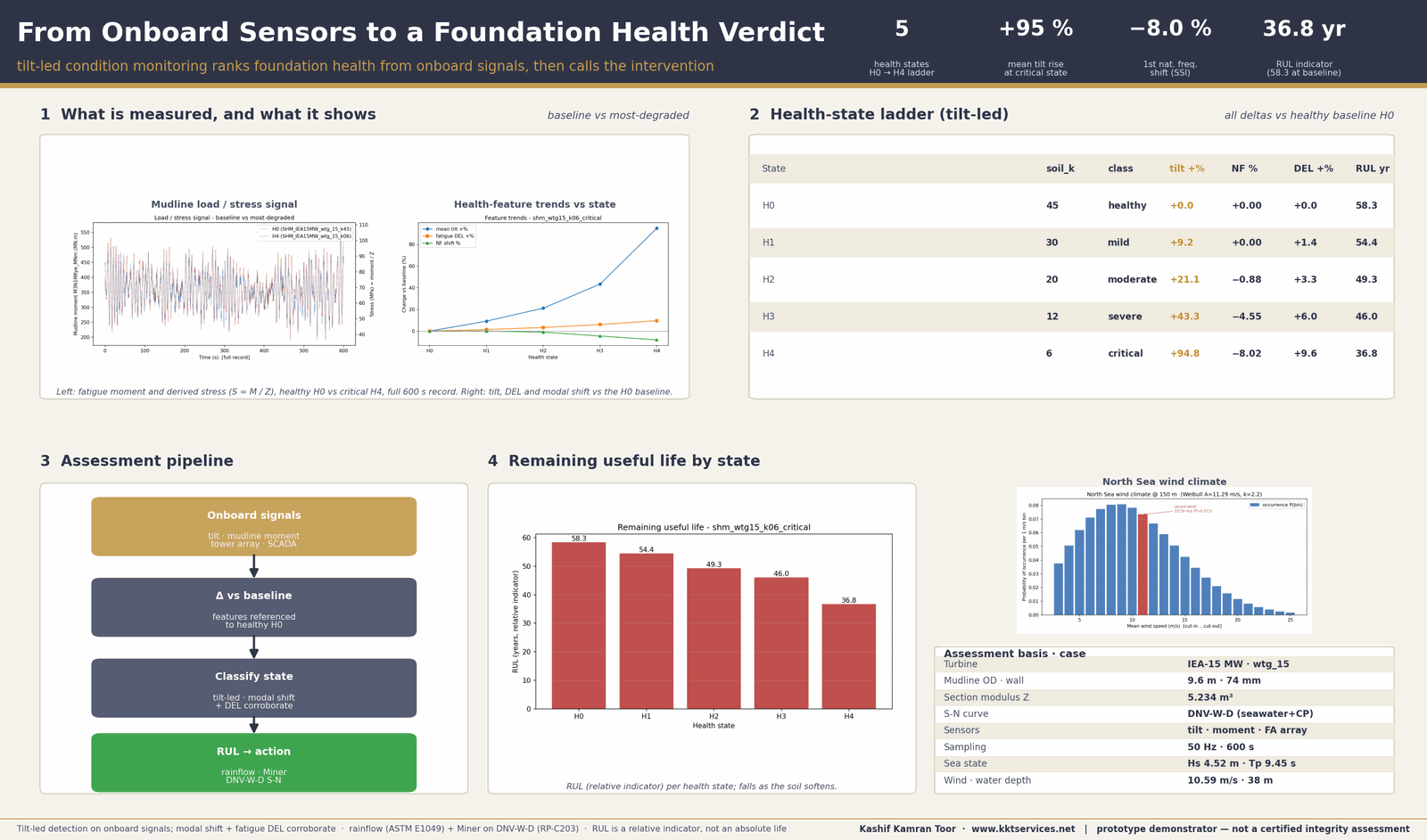
Structural health monitoring — physics-informed condition monitoring: tilt-led damage-state classification, operational modal analysis (SSI-cov) and remaining-useful-life indication from onboard sensor and SCADA data. MIT xPRO capstone topic, carried into a working demonstrator.
Certification & design briefs — DNV, API, NORSOK, Eurocode; QA of FE analyses for project certification.
Project & process management
Structured decision-making and process automation, certified through MIT xPRO and ASME.
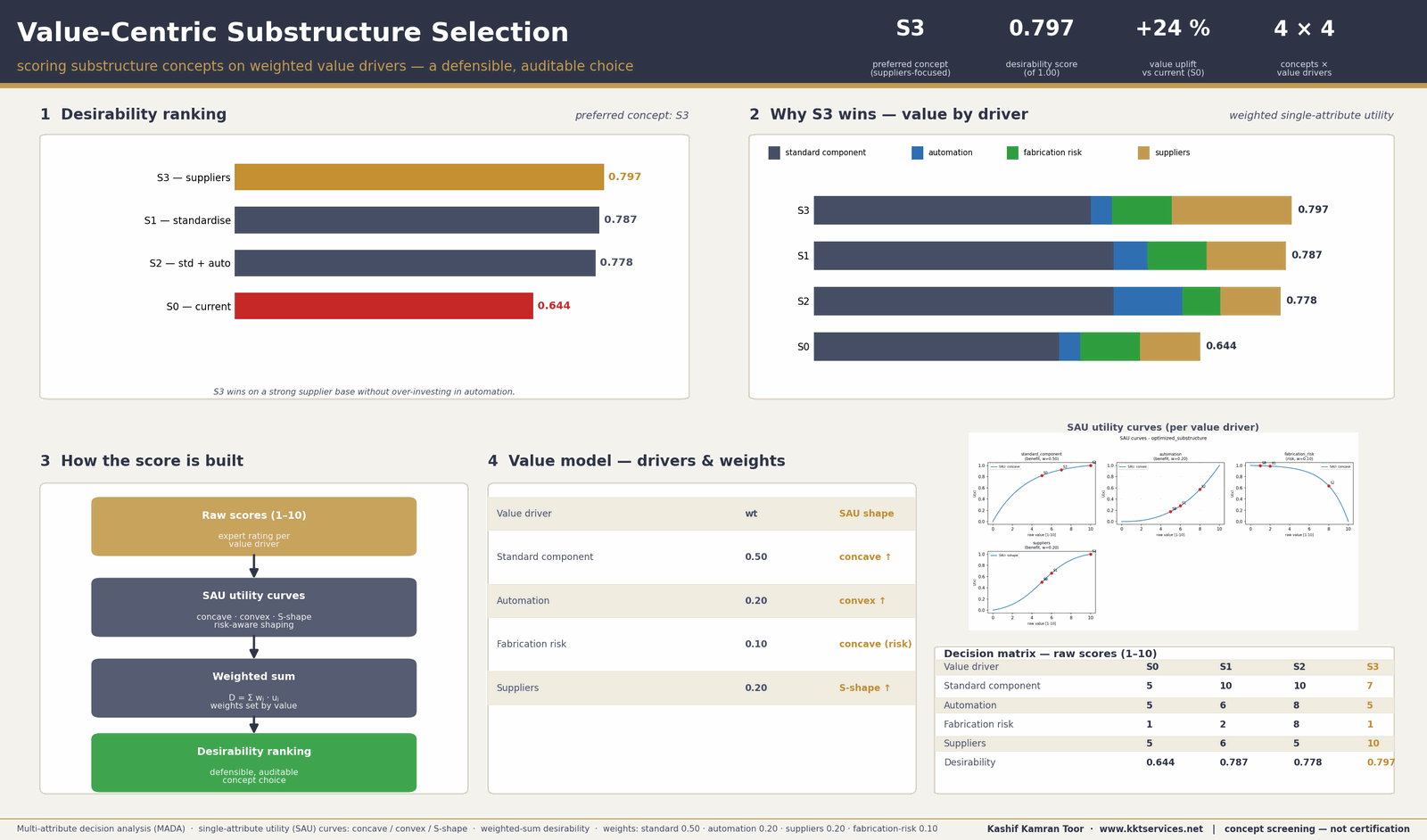
MADA — multi-attribute decision analysis for quantitative concept screening across cost, mass, manufacturability and certification.
Value-centric concept evaluation — early-phase design comparison weighting business and technical value together.
Process automation — SCF calculation interfacing global & local FE models; HPC-automated Influence-Factor generation for full jacket substructures.
Technology development — AI/ML tools deployed into system-engineering workflows at Vattenfall.
Selected work
A visual sample of FEA, simulation and toolkit work across offshore wind foundation design, structural integrity assessment, concept-stage cost estimation and process automation.
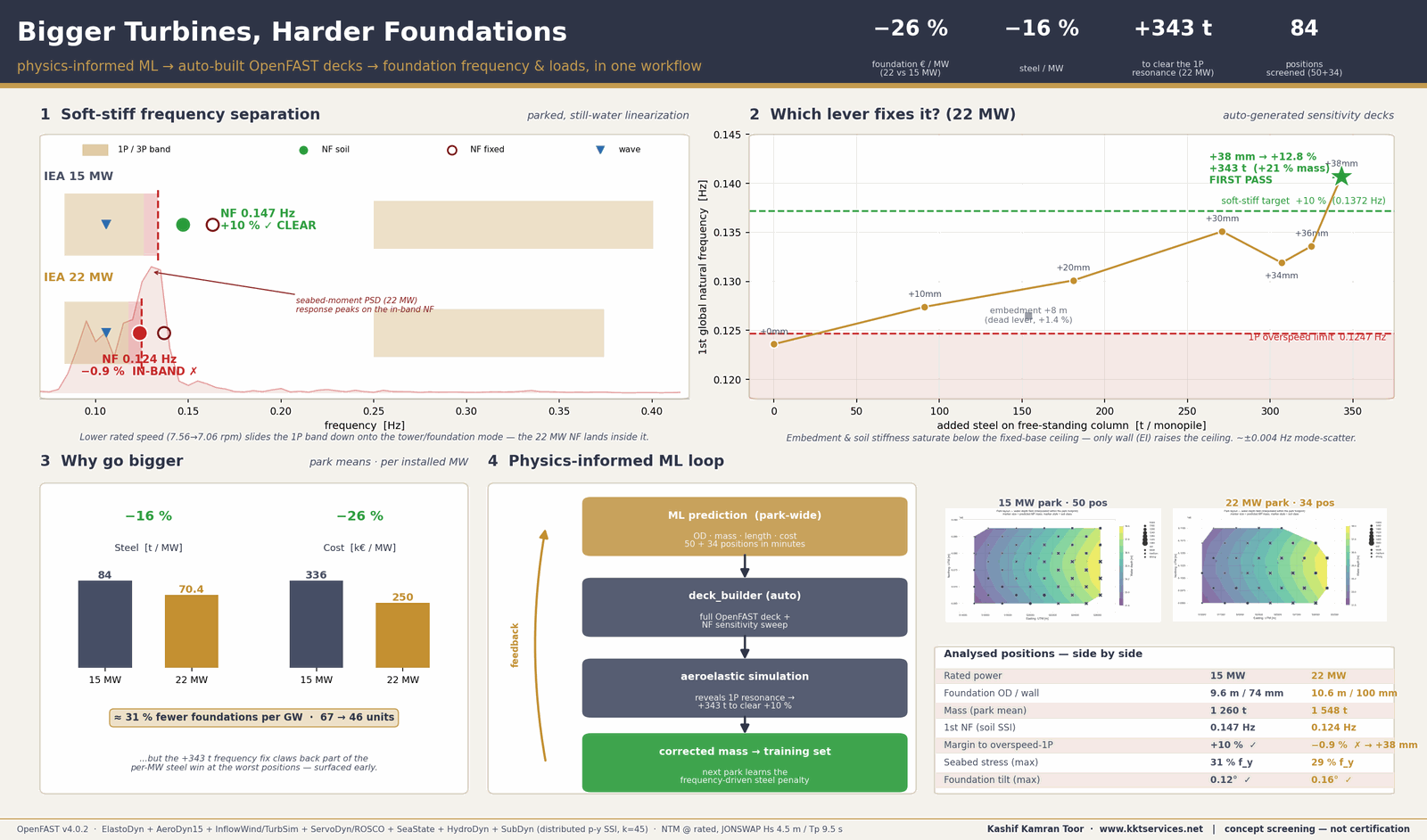
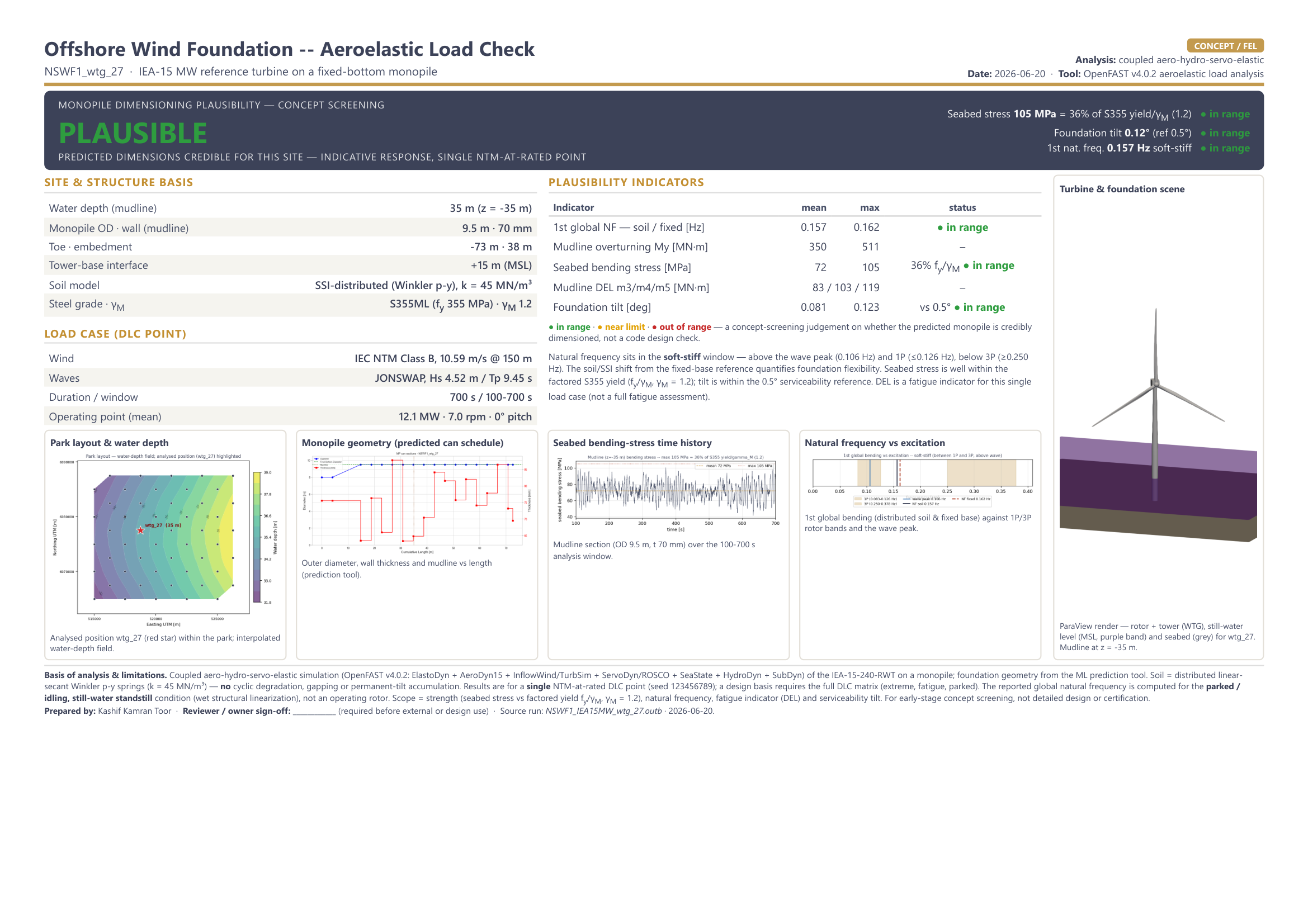
Concept Load Analysis — physics-informed ML sizes a whole park, auto-built OpenFAST decks then reveal a 22 MW 1P resonance the sizing alone missed, and the study quantifies the steel needed to clear it (IEA 15 MW vs 22 MW, demo data).
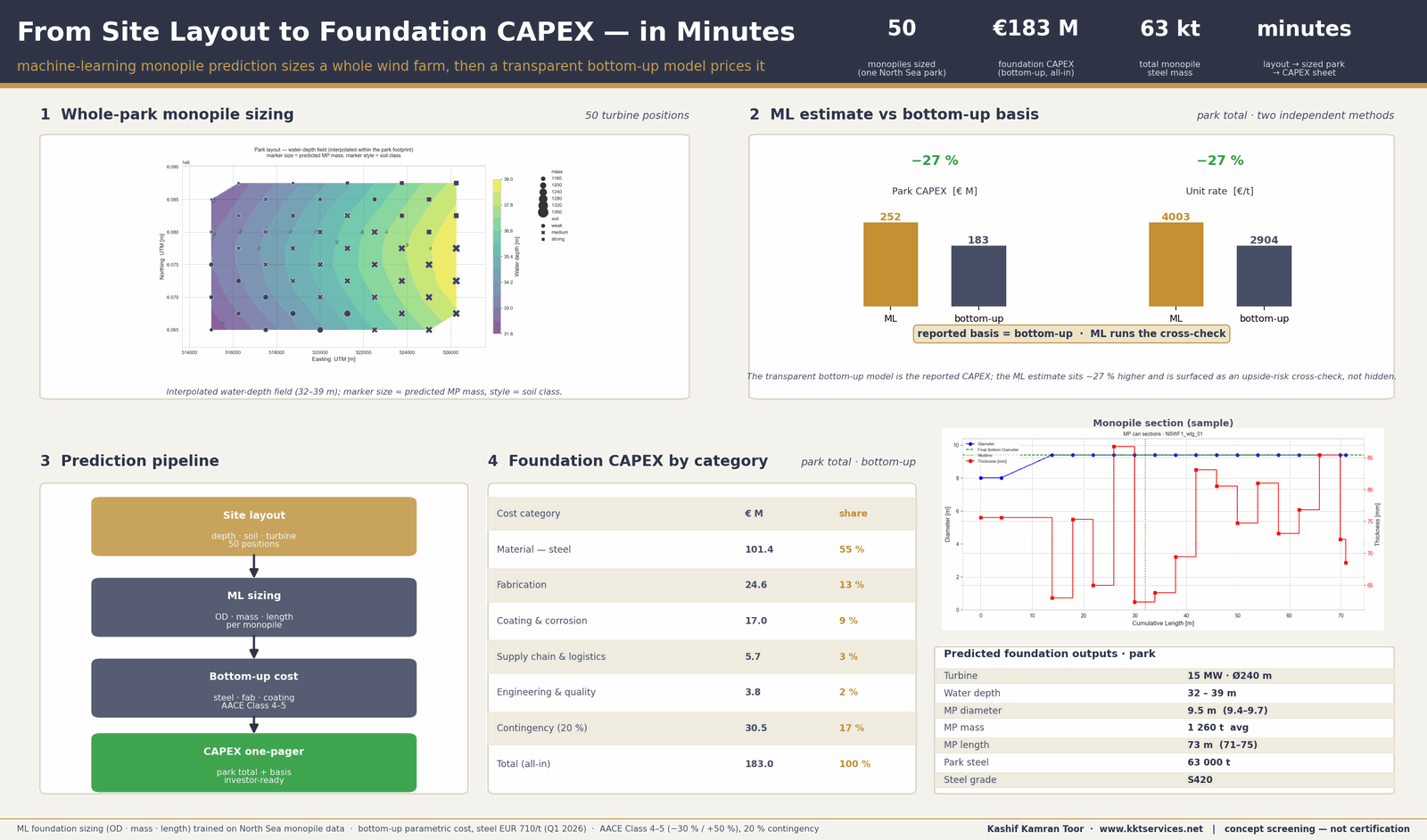
MP Mass Predictor — machine-learning monopile sizing across a whole wind farm, priced by a transparent bottom-up cost model (50 positions, EUR 183 M, demo data).
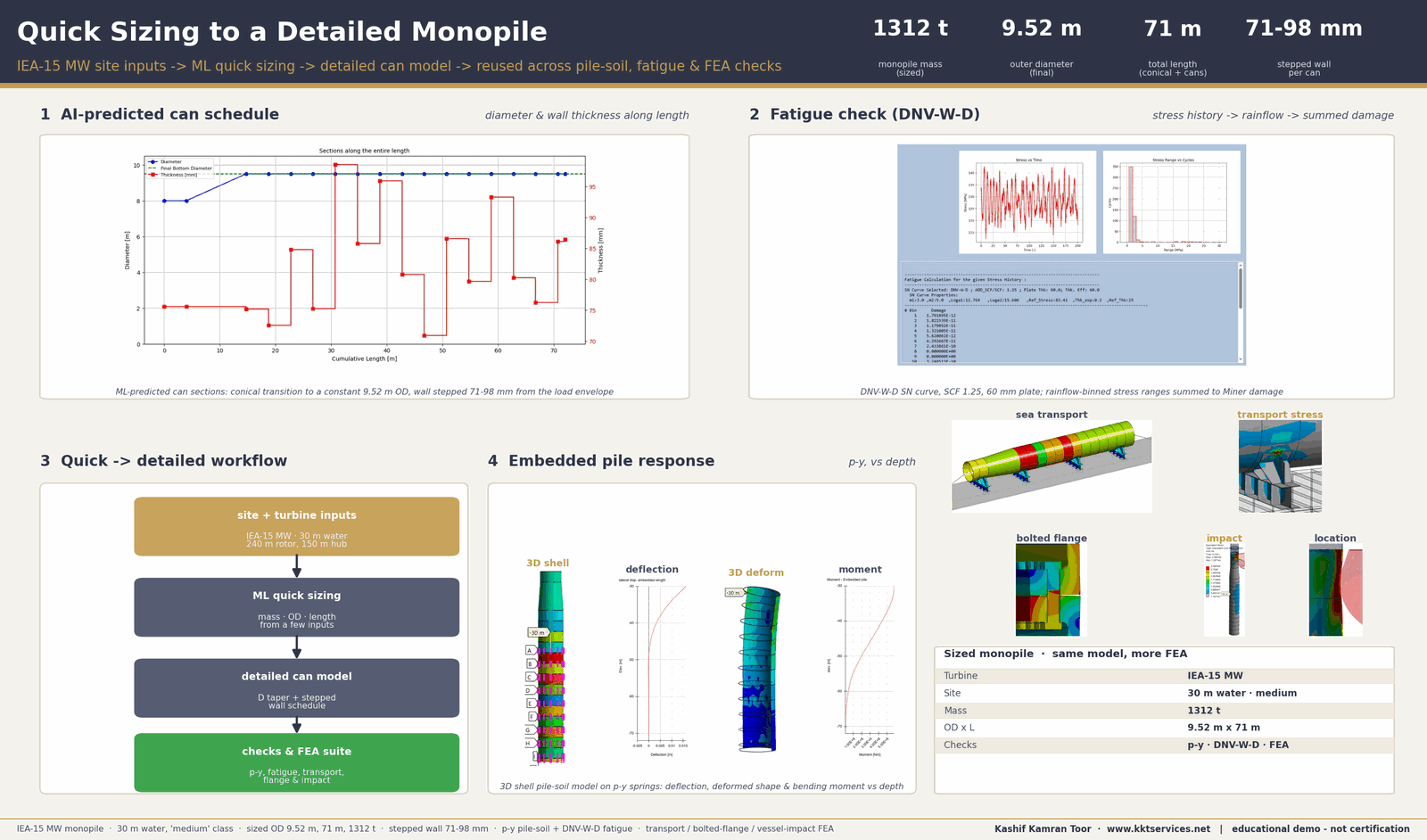
Quick monopile design — a handful of IEA 15 MW site inputs become a fully sized monopile (1312 t, OD 9.52 m, 71 m) with an AI-predicted can schedule, p-y pile-soil response and a DNV-W-D fatigue check; the same detailed model then feeds transport, bolted-flange and vessel-impact FEA (educational demo).
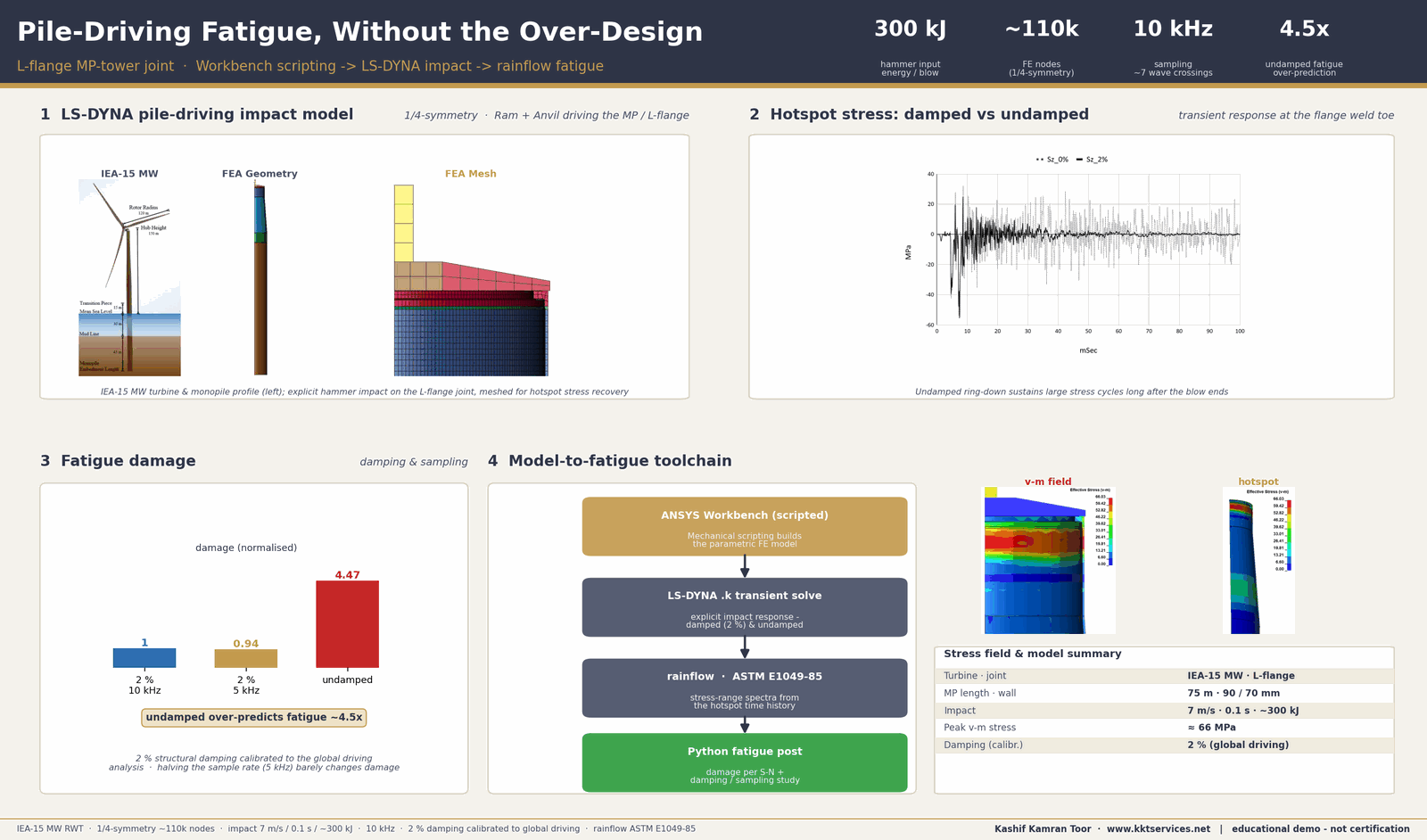
Pile-driving transient dynamics (LS-DYNA) — explicit hammer-impact FEA of an L-flange monopile joint; 2% calibrated damping cuts predicted fatigue ~4.5× versus undamped (IEA 15 MW, educational demo).
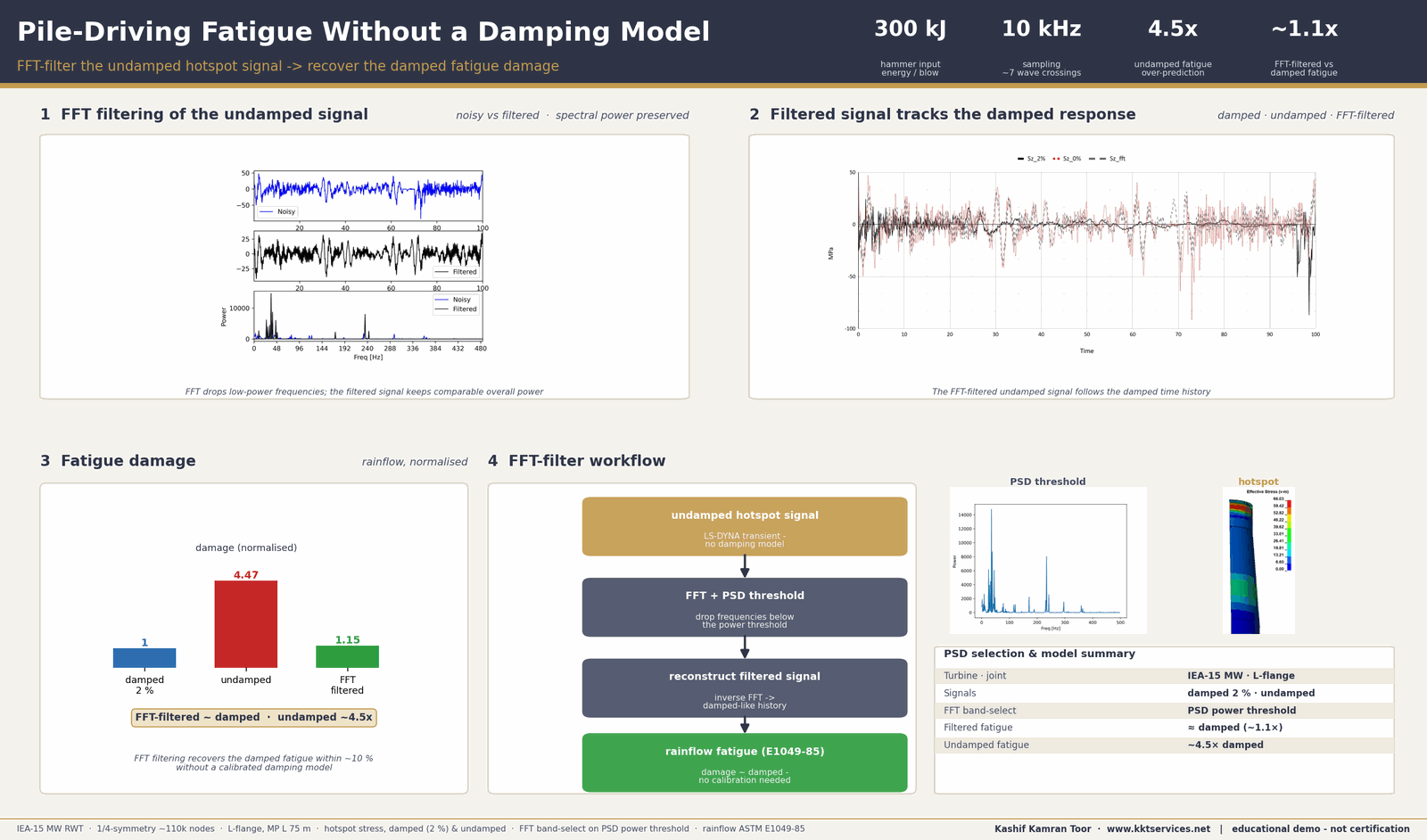
Pile-driving induced fatigue, FFT approach (LS-DYNA) — when soil damping is not calibrated, FFT-filtering the undamped hotspot signal recovers the damped fatigue within ~10% (IEA 15 MW, educational demo).
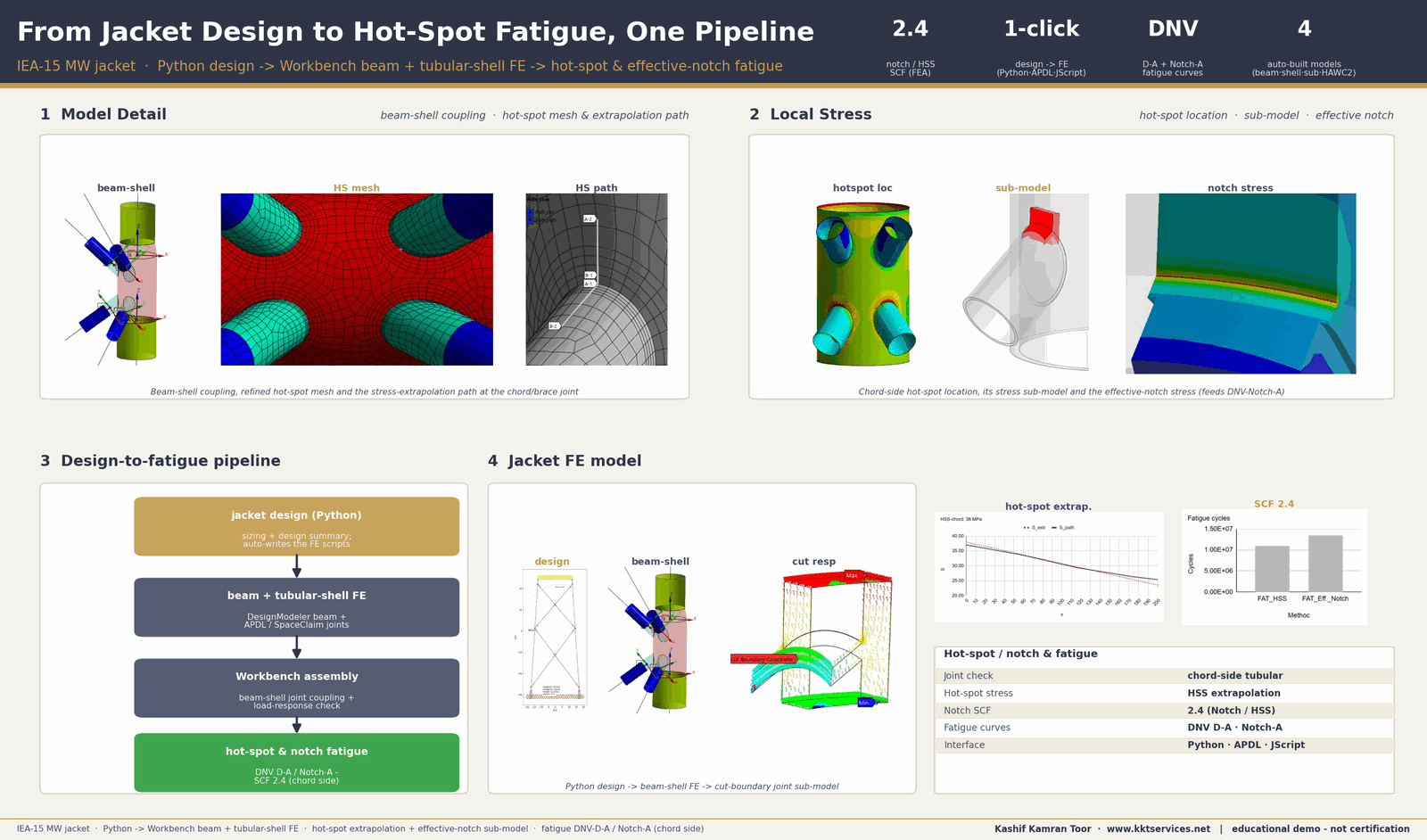
SCF for tubular joints, jacket substructure — a seamless Python → ANSYS Workbench pipeline builds beam + tubular-shell FE and recovers hot-spot & effective-notch fatigue (SCF 2.4, DNV D-A/Notch-A; IEA 15 MW, educational demo).
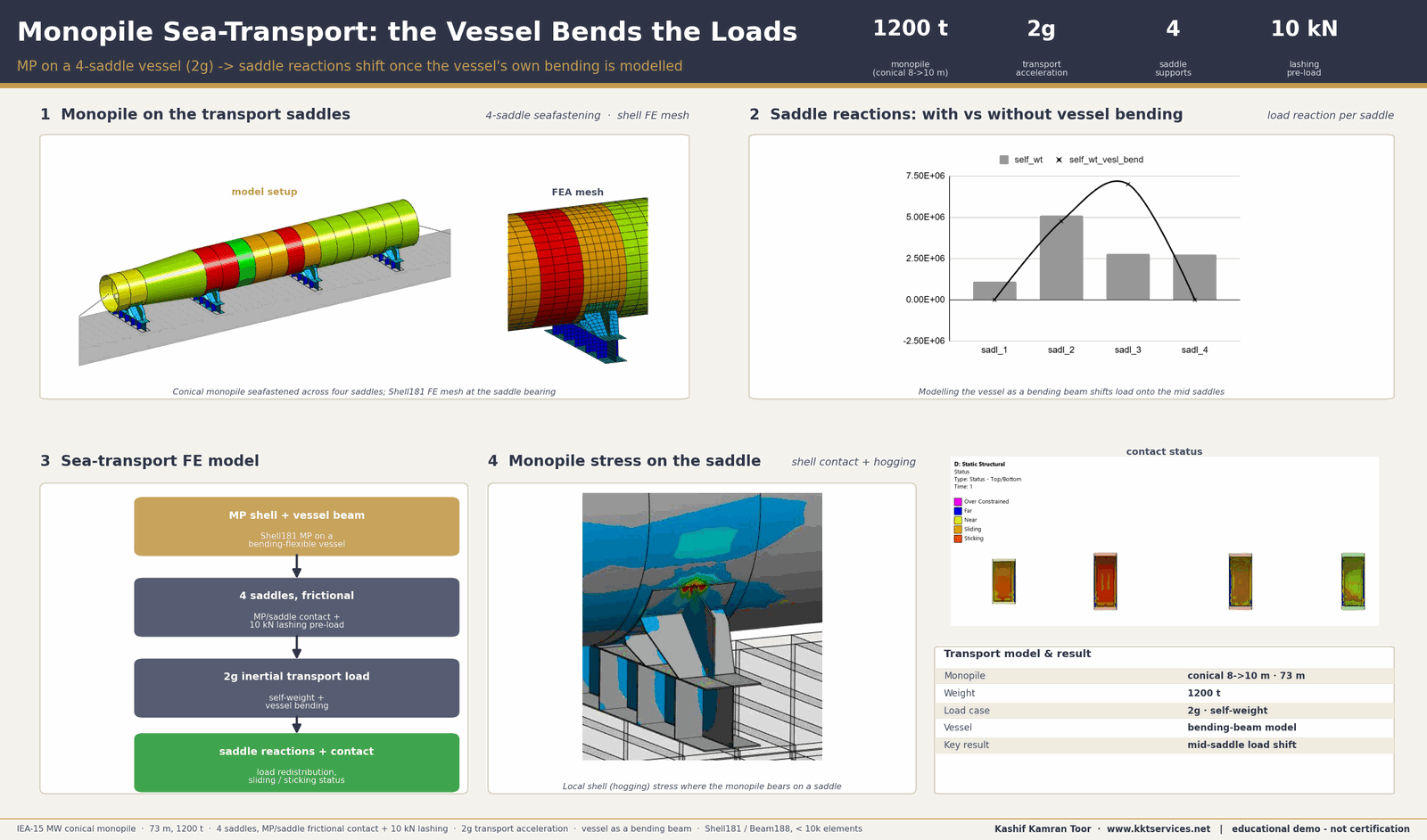
Monopile sea-transport hogging analysis — a 1200 t conical monopile seafastened on four saddles under 2g; modelling the vessel's own bending redistributes the saddle loads (IEA 15 MW, educational demo).
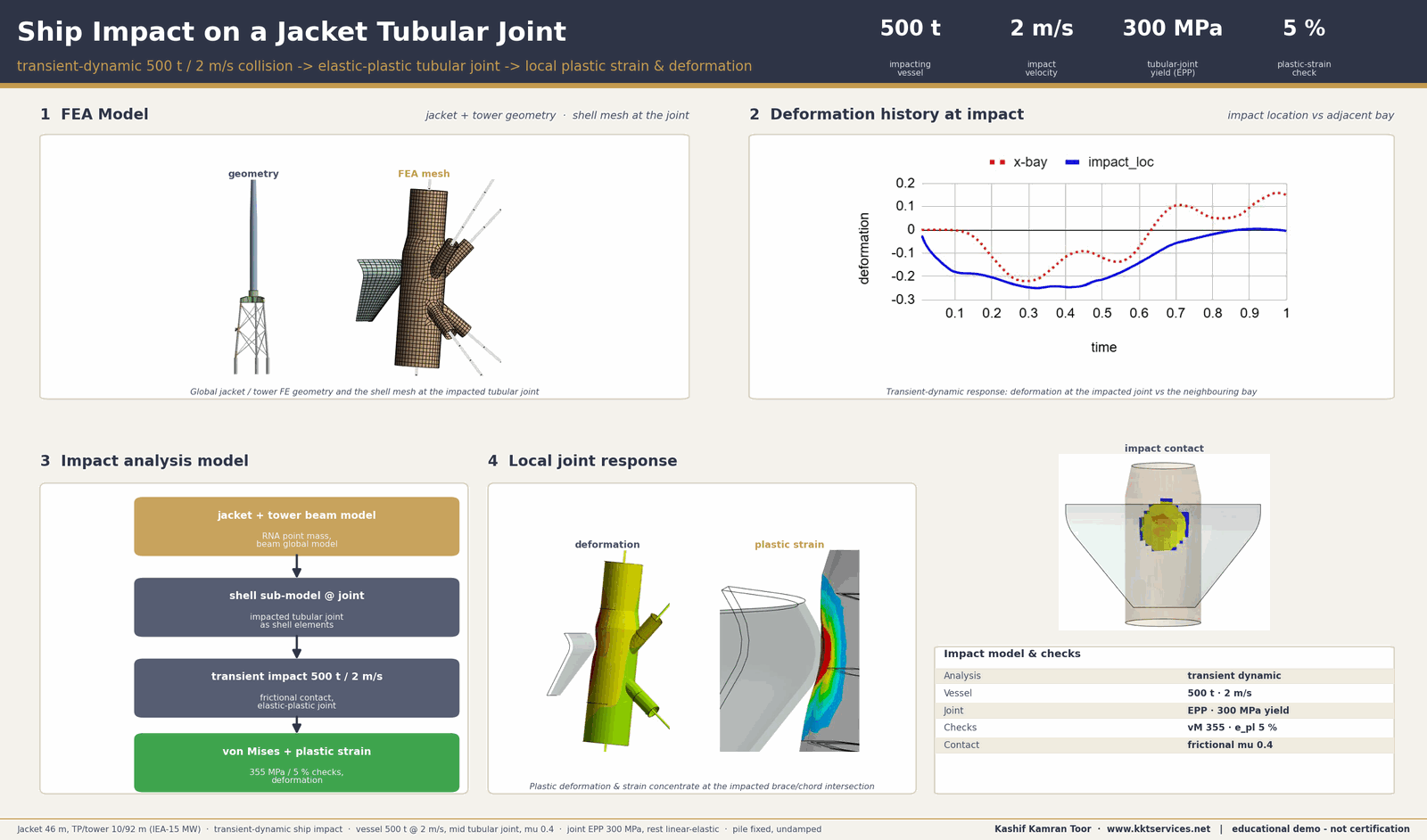
Vessel impact & collision analysis — transient-dynamic 500 t / 2 m/s ship impact on a jacket tubular joint (elastic-plastic, 300 MPa) resolving local plastic strain & deformation (IEA 15 MW, educational demo).
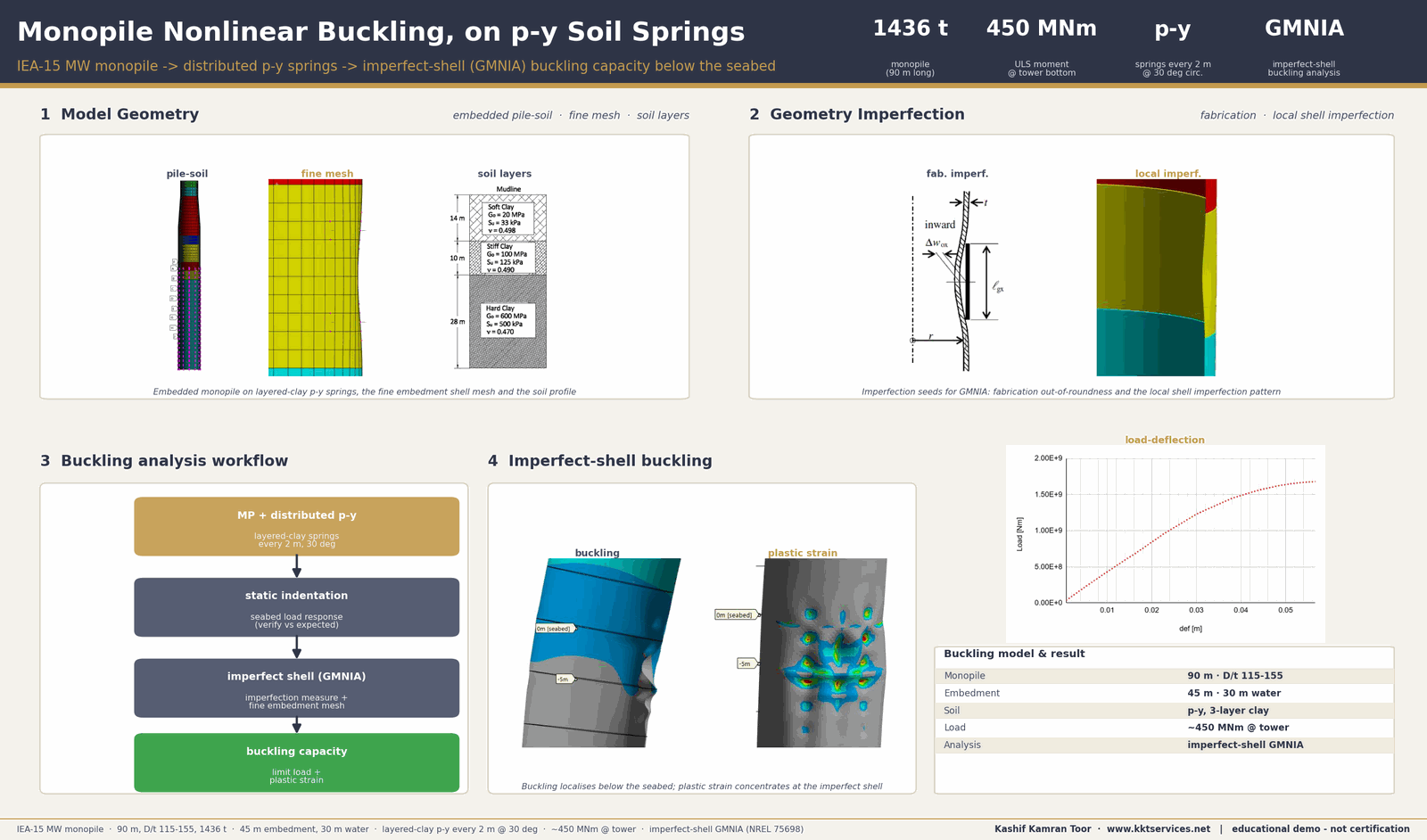
Non-linear buckling with pile-soil interaction — imperfect-shell (GMNIA) buckling capacity of a monopile on distributed p-y springs, localising below the seabed under ~450 MNm (IEA 15 MW, educational demo).
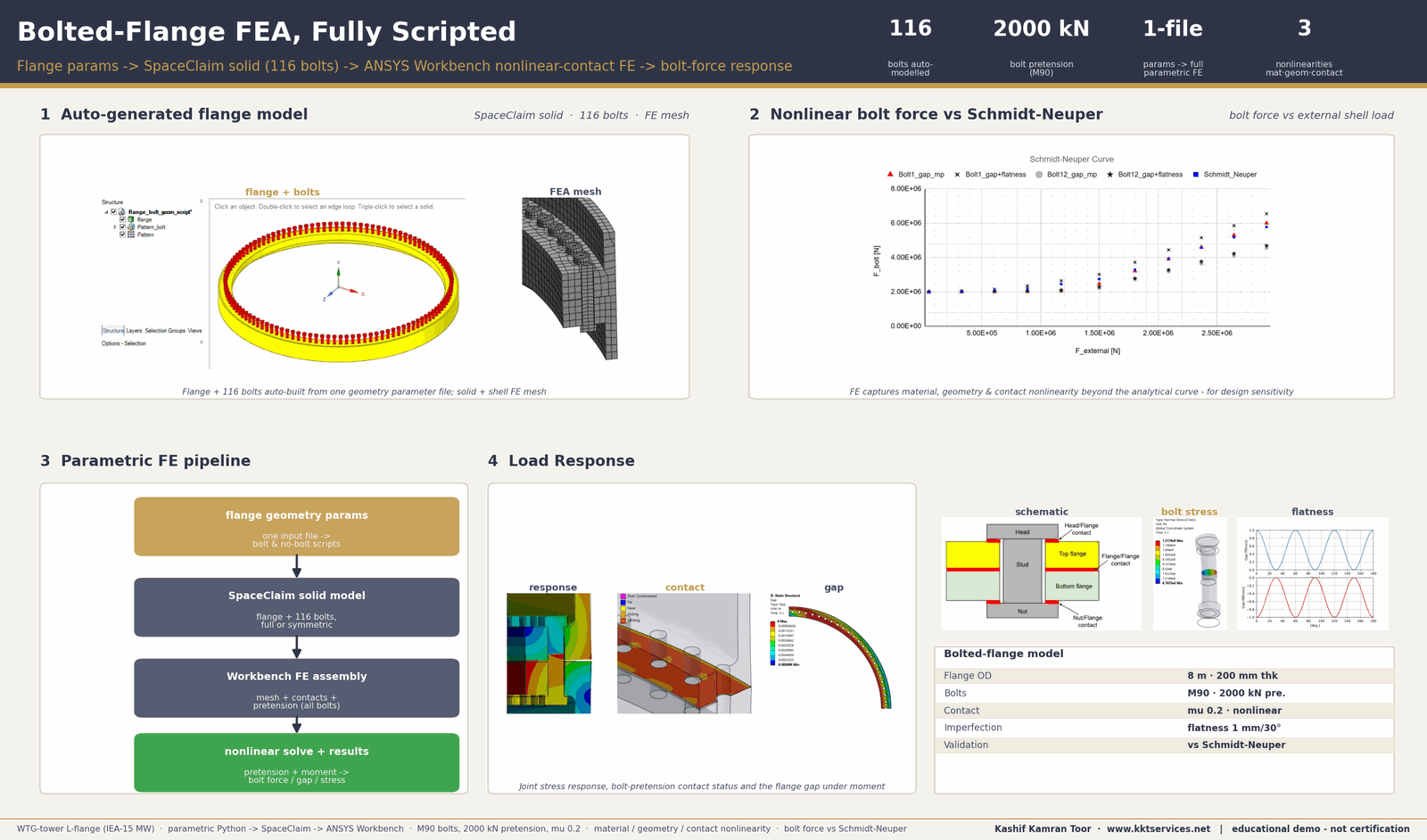
FEA automation for bolted-flange connections — a parametric Python → SpaceClaim → ANSYS Workbench pipeline builds a 116-bolt WTG-tower flange model and recovers the nonlinear bolt-force response versus Schmidt-Neuper (IEA 15 MW, educational demo).
Structural health monitoring — tilt-led, physics-informed condition monitoring ranks foundation health across a soil-stiffness ladder (H0 → H4); mean tilt leads detection, modal shift and fatigue DEL corroborate, and the RUL indicator falls 58.3 → 36.8 yr at critical (IEA 15 MW, prototype demo).
Value-centric concept evaluation — MADA ranking of substructure options across cost, mass, manufacturability and certification (demo data).